Wednesday, October 31, 2012


Tuesday, October 30, 2012
Months after death, Sherman Hemsley not buried

RELATED CONTENT
- Sherman Hemsley
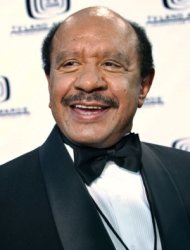
Sherman Hemsley died on July 24 from lung cancer, but the late television star has still not been buried due to a legal battle over his estate and his final resting place.
Hemsley, best known for his 11 seasons on the CBS sitcom "The Jeffersons," left behind an estate of approximately $50,000. He was not married and had no children. According to Fox News, Hemsley left his estate to Flora Enchinton Bernal, his "self-proclaimed business partner and live-in best friend." There is a will attesting to this. However, a man named Richard Thornton came forward after Hemsley's death, claiming to be his brother. Thornton filed a civil lawsuit calling into question the will.
[Related: TV Stars We've Lost in 2012]
A trial was supposedly set for September, but that got delayed until October in order for Thornton to get a DNA test. In addition, a woman and her son, the Rev. Michael George Wells, are insisting that the woman was a relative to Hemsley. "We are family, and we are not looking for money. But if we are entitled to something, we don’t want anyone else to have it,” Wells told the El Paso Times.
The money is one thing; the burial is something else. Even there, folks don't seem able to agree. Bernal has told authorities that Hemsley wanted to be buried in El Paso, Texas, where he'd lived for several decades. Others believe Hemsley should be buried in Pennsylvania, near his family.
A reporter from KTSM spoke to Bernal's attorney about the process. "It's been very difficult," Neill said. "I think she feels very responsible for Mr. Hemsley. She feels a deep desire to give him his final resting place and give him the dignity that comes with that. Obviously we've been delayed in order to get that resolution here, so I think it's been a combination of very frustrating and just... very emotional and difficult for her."
The judge is expected to make a final ruling on October 31.-
Monday, October 29, 2012

Sunday, October 28, 2012
Regan Sandy update...
Sos a Regan NYC Sandy update. All bus and subway service suspended. Even cabbies wont be on the road. What do we do? Rent a car!! Ummm Yeah ok. You seen the movie I am Legend? Yeah Ima be driving like that cept a Shelby Mustang GT500 Ima be in a Nissan Sentra!! Ima tay shay up in NYC!!!

AP poll: Majority harbor prejudice against blacks
AP poll: Majority harbor prejudice against blacks
By | Associated Press – Sat, Oct 27, 2012- Enlarge Photo
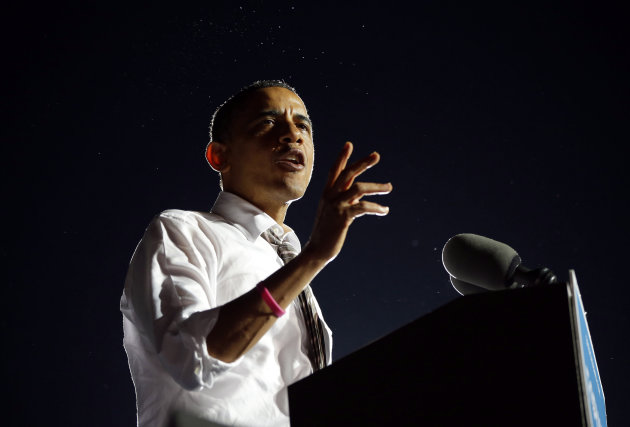 Associated Press/Pablo Martinez Monsivais - FILE - In this Oct. 25, 2012 file photo, President Barack Obama speaks to supporters at a campaign event at Cleveland Burke Lakefront Airport, in Cleveland Ohio.
WASHINGTON (AP) — Racial attitudes have not improved in the four years since the United States elected its first black president, an Associated Press poll finds, as a slight majority of Americans now express prejudice toward blacks whether they recognize those feelings or not.
Those views could cost President Barack Obama votes as he tries for re-election, the survey found, though the effects are mitigated by some people's more favorable views of blacks.
Racial prejudice has increased slightly since 2008 whether those feelings were measured using questions that explicitly asked respondents about racist attitudes, or through an experimental test that measured implicit views toward race without asking questions about that topic directly.
In all, 51 percent of Americans now express explicit anti-black attitudes, compared with 48 percent in a similar 2008 survey. When measured by an implicit racial attitudes test, the number of Americans with anti-black sentiments jumped to 56 percent, up from 49 percent during the last presidential election. In both tests, the share of Americans expressing pro-black attitudes fell.
"As much as we'd hope the impact of race would decline over time ... it appears the impact of anti-black sentiment on voting is about the same as it was four years ago," said Jon Krosnick, a Stanford University professor who worked with AP to develop the survey.
Most Americans expressed anti-Hispanic sentiments, too. In an AP survey done in 2011, 52 percent of non-Hispanic whites expressed anti-Hispanic attitudes. That figure rose to 57 percent in the implicit test. The survey on Hispanics had no past data for comparison.
The AP surveys were conducted with researchers from Stanford University, the University of Michigan and NORC at the University of Chicago.
Experts on race said they were not surprised by the findings.
"We have this false idea that there is uniformity in progress and that things change in one big step. That is not the way history has worked," said Jelani Cobb, professor of history and director of the Institute for African-American Studies at the University of Connecticut. "When we've seen progress, we've also seen backlash."
Obama has tread cautiously on the subject of race, but many African-Americans have talked openly about perceived antagonism toward them since Obama took office. As evidence, they point to events involving police brutality or cite bumper stickers, cartoons and protest posters that mock the president as a lion or a monkey, or lynch him in effigy.
"Part of it is growing polarization within American society," said Fredrick Harris, director of the Institute for Research in African-American Studies at Columbia University. "The last Democrat in the White House said we had to have a national discussion about race. There's been total silence around issues of race with this president. But, as you see, whether there is silence, or an elevation of the discussion of race, you still have polarization. It will take more generations, I suspect, before we eliminate these deep feelings."
Overall, the survey found that by virtue of racial prejudice, Obama could lose 5 percentage points off his share of the popular vote in his Nov. 6 contest against Republican challenger Mitt Romney. But Obama also stands to benefit from a 3 percentage point gain due to pro-black sentiment, researchers said. Overall, that means an estimated net loss of 2 percentage points due to anti-black attitudes.
The poll finds that racial prejudice is not limited to one group of partisans. Although Republicans were more likely than Democrats to express racial prejudice in the questions measuring explicit racism (79 percent among Republicans compared with 32 percent among Democrats), the implicit test found little difference between the two parties. That test showed a majority of both Democrats and Republicans held anti-black feelings (55 percent of Democrats and 64 percent of Republicans), as did about half of political independents (49 percent).
Obama faced a similar situation in 2008, the survey then found.
The AP developed the surveys to measure sensitive racial views in several ways and repeated those studies several times between 2008 and 2012.
The explicit racism measures asked respondents whether they agreed or disagreed with a series of statements about black and Hispanic people. In addition, the surveys asked how well respondents thought certain words, such as "friendly," ''hardworking," ''violent" and "lazy," described blacks, whites and Hispanics.
The same respondents were also administered a survey designed to measure implicit racism, in which a photo of a black, Hispanic or white male flashed on the screen before a neutral image of a Chinese character. The respondents were then asked to rate their feelings toward the Chinese character. Previous research has shown that people transfer their feelings about the photo onto the character, allowing researchers to measure racist feelings even if a respondent does not acknowledge them.
Results from those questions were analyzed with poll takers' ages, partisan beliefs, views on Obama and Romney and other factors, which allowed researchers to predict the likelihood that people would vote for either Obama or Romney. Those models were then used to estimate the net impact of each factor on the candidates' support.
All the surveys were conducted online. Other research has shown that poll takers are more likely to share unpopular attitudes when they are filling out a survey using a computer rather than speaking with an interviewer. Respondents were randomly selected from a nationally representative panel maintained by GfK Custom Research.
Overall results from each survey have a margin of sampling error of approximately plus or minus 4 percentage points. The most recent poll, measuring anti-black views, was conducted Aug. 30 to Sept. 11.
Andra Gillespie, an Emory University political scientist who studies race-neutrality among black politicians, contrasted the situation to that faced by the first black mayors elected in major U.S. cities, the closest parallel to Obama's first-black situation. Those mayors, she said, typically won about 20 percent of the white vote in their first races, but when seeking reelection they enjoyed greater white support presumably because "the whites who stayed in the cities ... became more comfortable with a black executive."
"President Obama's election clearly didn't change those who appear to be sort of hard-wired folks with racial resentment," she said.
Negative racial attitudes can manifest in policy, noted Alan Jenkins, an assistant solicitor general during the Clinton administration and now executive director of the Opportunity Agenda think tank.
"That has very real circumstances in the way people are treated by police, the way kids are treated by teachers, the way home seekers are treated by landlords and real estate agents," Jenkins said.
Hakeem Jeffries, a New York state assemblyman and candidate for a congressional seat being vacated by a fellow black Democrat, called it troubling that more progress on racial attitudes had not been made. Jeffries has fought a New York City police program of "stop and frisk" that has affected mostly blacks and Latinos but which supporters contend is not racially focused.
"I do remain cautiously optimistic that the future of America bends toward the side of increased racial tolerance," Jeffries said. "We've come a long way, but clearly these results demonstrate there's a long way to go."
___
AP News Survey Specialist Dennis Junius contributed to this report.
___
Online:
Poll results: http://surveys.ap.org
Academic analysis: http://tinyurl.com/8pzbebm
Ok I know its breast cancer awareness month (should be a year round thing in my opinion) and the NFL is trying to do its part but some if these players look a bit too "HAPPY" in that pink!! NO Im not being homophobic!! Im really just sayin dont let this month be the reason you show your "TRUE COLORS!!"

Cities order mass evacuations as Sandy nears
Cities order mass evacuations as Sandy nears
A car goes through the high water as Hurricane Sandy bears down on the East Coast, Sunday, Oct. 28, 2012, in Ocean City, Md. Governors from North Carolina, where steady rains were whipped by gusting winds Saturday night, to Connecticut declared states of emergency. Delaware ordered mandatory evacuations for coastal communities by 8 p.m. Sunday. / AP
SHIP BOTTOM, N.J.Tens of thousands of people were ordered to evacuate coastal areas Sunday as big cities and small towns across the U.S. Northeast braced for the onslaught of a superstorm threatening some 60 million people along the most heavily populated corridor in the nation.
"The time for preparing and talking is about over," Federal Emergency Management Administrator Craig Fugate warned as a monster Hurricane Sandy headed up the Atlantic Coast on a collision course with two other weather systems. "People need to be acting now."

New York City announced its subways, buses and trains would stop running Sunday night starting 7 p.m. ET, and its 1.1 million-student school system would be closed on Monday. Mayor Michael Bloomberg also ordered the evacuation of part of lower Manhattan and other low-lying neighborhoods.
"If you don't evacuate, you are not only endangering your life, you are also endangering the lives of the first responders who are going in to rescue you," Bloomberg said. "This is a serious and dangerous storm."
Tens of thousands of people along the coast in Delaware, New Jersey, Connecticut and other threatened areas were also under orders to clear out because of as much as a foot of rain, punishing winds of 80 mph, and a potentially deadly tidal surge of 4 to 8 feet.
- Air, train, transit disruptions from Hurricane Sandy
- Hurricane Sandy storm tracker and forecast maps
- Sandy could wreak havoc across 800 miles of U.S.
Sandy was headed north from the Caribbean, where it left at least 65 people dead, mostly in Haiti, and was expected to hook left toward the mid-Atlantic coast and come ashore late Monday or early Tuesday, most likely in New Jersey, colliding with a wintry storm moving in from the west and cold air streaming down from the Arctic.
Forecasters warned that the resulting megastorm could wreak havoc over 800 miles from the East Coast to the Great Lakes. Parts of West Virginia, Virginia, Kentucky and North Carolina could get snow -- 2 feet or more in places.

The danger was hardly limited to coastal areas, with worried about inland flooding. They also warned that the rain could saturate the ground, causing trees to topple onto power lines and cause blackouts that could last for several days.
States of emergency were declared from North Carolina, where gusty winds whipped steady rain on Sunday morning, to Connecticut. Delaware ordered 50,000 people in coastal communities to clear out by 8 p.m. Sunday.
Officials in New York City were particularly worried about the possibility of subway flooding. The city closed the subways before Hurricane Irene last year, and a Columbia University study predicted that an Irene surge just 1 foot higher would have paralyzed lower Manhattan.
Sandy was at Category 1 strength, packing 75 mph winds, about 250 miles southeast of Cape Hatteras, North Carolina, and moving northeast at 14 mph as of 11 a.m. ET Sunday, according to the National Hurricane Center in Miami. It was about 575 miles south of New York City.
The storm was expected to continue moving parallel to the Southeast coast most of the day and approach the coast of the mid-Atlantic states by Monday night, before reaching southern New England later in the week.
The storm was so big, however, and the convergence of the three storms so rare, that "we just can't pinpoint who is going to get the worst of it," said Rick Knabb, director of the National Hurricane Center in Miami.

Bobbie Foote said she would heed an evacuation order Sunday for south Wilmington, Delaware, and would take shelter at her daughter's home in nearby Newark.
"My daughter insists that I leave this time," said Foote, a 58-year-old fitness coach. It will be the first time she has fled a storm threatening the apartment building that has been her home for at least 40 years in the working-class neighborhood near the Delaware River.
- no previous page
- next
1/2
David Robert Moore III, San Diego State Student, Arrested With Sniper Rifle In Car 10/28/12 12:11 AM ET EDT
David Robert Moore III, San Diego State Student, Arrested With Sniper Rifle In Car
10/28/12 12:11 AM ET EDT 


SAN DIEGO -- A 20-year-old San Diego State student faces charges after officers discovered a cache of firearms in the trunk of his car.
When Moore opened the trunk of his white Honda Civic, two officers noticed what appeared to be military-grade weapons inside. They found nine guns, including a modified sniper rifle, a pistol and a rifle.
A military knife was also discovered.
Moore was given a field sobriety test and arrested on suspicion of drunken driving.
Police say he could also face charges for the weapons
Subscribe to:
Posts (Atom)